
Sermons and Politics over Workers’ Sweat : Riyadul Hasan
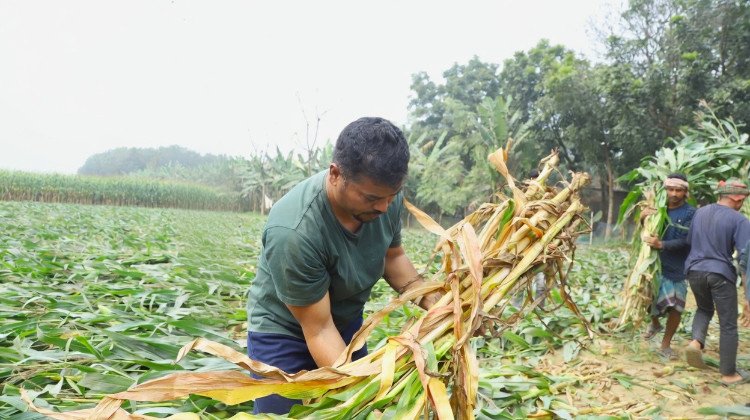
Like every year, International Workers’ Day was observed this year as well. With the combined impact of COVID-19, the Russia-Ukraine war, tensions between the United States and Iran, and rising inflation, the working-class people of our country are going through severe financial hardship. The main reason is unemployment. Therefore, Islam’s perspective on laborers is more relevant now than ever before.
Allah has created humankind as labor-dependent and social beings (Surah Al-Balad: 4). When people become dependent on others instead of relying on their own labor, and self-centered instead of social, negative consequences inevitably arise, leading to instability and crisis. This is why reluctance toward labor, devaluation of work, and unemployment have become major issues in our society.
Many politicians in our society speak loudly about workers’ rights. Especially during May Day, they hold numerous rallies and meetings to strengthen their leadership and power. In contrast, religious figures are rarely seen speaking up about workers’ rights. There are several reasons behind this indifference:
Firstly, many of them interpret religion as limited to prayers, fasting, sermons, and religious gatherings. Instead of striving to reduce injustice and the suffering of the deprived, they focus more on counting prayer beads and increasing their spiritual deeds. Due to a distorted understanding of worship and the path to gaining Allah’s pleasure, they are not concerned about the hardships of workers.
Secondly, many religious leaders rely solely on madrasa education, learning some prayers and religious rulings, and live comfortably based on that. Therefore, how can they understand the backbreaking labor of workers? Someone who has never had to struggle for a handful of food cannot truly grasp why a worker’s wage must be paid before their sweat dries.
Thirdly, many scholars do not see Workers’ Day as related to Islam, since it has no direct connection to Islamic history or the Muslim Ummah. Some even consider observing May Day as imitation of non-believers or unnecessary innovation. Due to this narrow perspective, they fail to understand the universal truth that Islam came for all humanity. Working for the peace and well-being of humanity is also part of Islam. They forget that the true greatness of Islam lies in restoring dignity to the oppressed and deprived. The final Messenger of Allah demonstrated this by marrying Maria al-Qibtiyya (RA), freeing and embracing Umm Ayman and Zayd (RA) into his family, and elevating Bilal (RA) to a position of great honor. Therefore, striving for the liberation of the oppressed is an essential duty for the Ummah of Muhammad—it is itself an act of worship.
The Messenger of Allah strongly opposed dependency throughout his life. He himself worked for his livelihood, herding camels and goats. During times of jihad, he actively participated in physical labor. During the construction of Masjid an-Nabawi and the digging of the trench, he was seen breaking stones, digging earth, and carrying bricks and soil on his shoulders. Ali (RA), known as the gate of knowledge, once drew water from a well for a Jewish woman in exchange for a few dates. But how much attention do those who preach religion today give to following these examples?
Our forefather Adam (AS) had to cultivate the barren land of the early earth and sustain life through hard labor. The Holy Bible also states: “…by the sweat of your face you shall eat bread… till you return to the ground.”
Therefore, it is the duty of the children of Adam to earn through labor and support their families. Allah has forbidden taking payment in exchange for religious duties such as leading prayers (Surah Al-Baqarah: 174). He commanded believers to stop trade at the call to Friday prayer and resume seeking livelihood afterward (Surah Al-Jumu’ah: 9–10). It is noteworthy that Islam does not encourage sitting idly or depending on others—even on Fridays.
In reality, all religions, including Islam, encourage people to work. Both asceticism and laziness are discouraged because they disrupt social balance. True religious teachings make people productive. No religion permits turning faith into a business.
The Prophet said that striving for livelihood is a human responsibility, and reliance on Allah does not mean abandoning effort. He also stated that all prophets earned through their own labor; thus, it is better to earn independently rather than become a burden on others. Begging is strongly discouraged in Islam.
Similar teachings are found in other scriptures. The Bhagavad Gita emphasizes the importance of action, and the Bible also declares labor essential for human life. All religious texts encourage earning through work. Even when workers may not be outwardly religious, they often follow this timeless principle. The satisfaction that comes from paying a worker their due wages immediately after their labor is something only a laborer can truly understand. That is why workers usually do not exploit one another.
On the other hand, those who follow Allah’s commands and ensure fair rights for workers will also refrain from exploitation. Without the combination of these two mindsets, true justice for workers cannot be established.
Not only religious figures, but politicians also form a dependent class. Therefore, their statements about workers’ rights are often deceptive. Workers’ suffering, deprivation, and struggles become political tools. The working class must understand this reality to avoid being misled.
Western materialistic civilization has also long deprived workers of their rights. When workers protested, they were oppressed. Later, those same forces created new political narratives through the observance of May Day. However, in reality, the condition of workers has not significantly improved; rather, deprivation and suffering have increased—something clearly reflected in statistics.
Images Related to this Post










Leave a Comment