
Transformation of Madrasas: From Centers of Knowledge to Narrowness
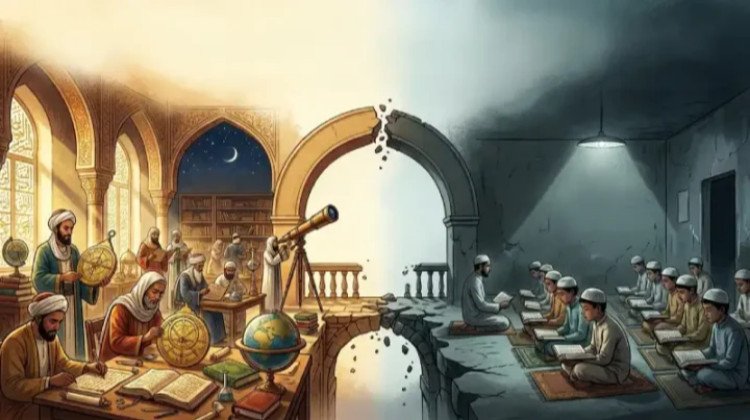
At present, when we refer to a madrasa, we understand it as a religious educational institution. In a secular state system, religion is now considered a personal matter. Religious laws or moral principles are not supposed to influence the governance of the state.
However, before Muslims came under British colonial rule, state affairs were largely governed by Islamic principles and values. Religion was not just personal; Islamic laws, economics, criminal justice, philosophy, and other disciplines were applied in governance. Therefore, madrasas at that time taught subjects relevant to state and national life within Islam. Students gained knowledge of Islamic jurisprudence (fiqh) and could apply it in courts—just as today students study British-based law in colleges and universities to become lawyers, barristers, and judges. The difference is that earlier Islamic law was taught, whereas now British law is taught.
Employment Crisis
Madrasas still teach fiqh and Shariah laws, and students memorize them mechanically. However, these laws are no longer applicable in national life. Religion has long been separated from the state, so madrasa graduates cannot find employment in courts. Instead, they work in mosques and religious institutions.
To create employment, countless madrasas are being established everywhere. There is little government control over them because religious institutions are considered sensitive and sacred. In democratic systems, governments often avoid interfering with religious sentiments. Taking advantage of this, disorder has spread in many madrasas—something regularly reported in the media but often ignored.
Irregularities and Abuse
Reports reveal that various unethical and criminal activities occur in some madrasas—ranging from abuse and severe mistreatment to more serious crimes. While some argue that such incidents happen in all educational institutions, this argument is weak. Madrasas are meant to teach morality and divine guidance. So why is there such moral failure?
The answer lies in flaws within the madrasa education system. Additionally, students are sometimes used in protests and conflicts, even being exposed to violence while their teachers withdraw.
The True Meaning of “Madrasa”
The word “madrasa” does not originally mean a religious school. It comes from the Arabic root meaning “to study” or “to learn.” Thus, a madrasa simply means a place of learning.
The Prophet Muhammad (peace be upon him) lived in a time when Arab society was immersed in ignorance. Through his teachings, he transformed individuals and society into a flourishing civilization.
He did not primarily teach technical linguistic sciences or detailed jurisprudential debates. Instead, he taught guidance, tawhid (oneness of God), and core beliefs, along with the Qur’anic revelations, and struggled to establish them in real life. The first revelation—“Read” (Surah Al-Alaq 1)—emphasizes acquiring knowledge.
In Makkah, he taught companions in gatherings such as the house of Arqam ibn Abi Arqam. His companions then spread that knowledge to others.
Educational System in Madinah
After migration to Madinah, learning primarily took place in the Prophet’s Mosque. Men and women attended and received both spiritual and practical education. New laws related to trade, marriage, inheritance, and warfare were taught as they were revealed.
Companions were trained in preaching, warfare, physical skills, medicine, and literacy. Even prisoners of war were freed in exchange for teaching literacy to children.
There was no formal institutional madrasa system at that time—no fixed curriculum or textbooks. Knowledge transmission was dynamic and practical.
Teaching Without Payment
The Prophet strictly forbade taking payment for teaching religious knowledge. Both Qur’anic teachings and Hadith emphasize that divine knowledge should be given sincerely for God’s sake, without seeking worldly gain.
Madrasas in the Golden Age of Islam
For about 1,000 years, the Muslim world had major centers of learning across the Middle East and North Africa. Cities like Baghdad and Cordoba were renowned. These madrasas taught not only Islamic law but also theology, medicine, mathematics, and philosophy.
They were often supported by the state or wealthy patrons, providing facilities like libraries and boarding. However, they lacked modern standardized degree systems.
The First University Founded by a Woman
In 859 CE, Fatima al-Fihri founded a madrasa in Morocco, now known as Al-Qarawiyyin University. It awarded degrees (ijazah) in various fields and is recognized as the oldest degree-granting university in the world.
Bayt al-Hikmah (House of Wisdom)
Established in Baghdad during the Abbasid era, it began as a translation center and grew into a major hub of research and learning. Scholars of various backgrounds contributed to advancements in mathematics, astronomy, medicine, and more.
It became the largest library of its time before being destroyed during the Mongol invasion.
Muslim Contributions to Science
During the Islamic Golden Age, scholars like Al-Khwarizmi, Ibn Sina (Avicenna), Al-Farghani, Al-Idrisi, and others made groundbreaking contributions to science, medicine, mathematics, and philosophy.
Their works influenced global knowledge and even contributed to the later European Renaissance.
Decline of Modern Madrasas
Today’s madrasas differ greatly from those of the past. Many focus narrowly on religious rulings and neglect science, technology, and broader intellectual development.
As a result, graduates often lack diverse skills and struggle with employment, relying mainly on religious roles for livelihood.
Conclusion: The Way Forward
It is clear that classical madrasas were centers of knowledge and civilization, while many modern madrasas have diverged from that role.
To address this:
- The Muslim community must unite on foundational principles.
- A system should be established that integrates religious and worldly knowledge.
- Education should combine faith, science, technology, and the arts.
Such a system would produce individuals who are both spiritually grounded and intellectually capable—leaders who can contribute meaningfully to society.
Images Related to this Post









Leave a Comment