
No Eid in Makkah, Why Eid in Madinah
Category :
Islamic Thought & Analysis

Riyadul Hasan
The Holy Quran was not revealed all at once in the form of a complete book; rather, its various injunctions were revealed gradually in accordance with the sequence of realities over the 23 years of the Prophetic life of the Messenger of Allah (PBUH). There is a deep connection between this process of the revelation of Wahi (divine inspiration) and the context and flow of events behind these injunctions. Therefore, it is difficult to comprehend the true teachings and essence of any injunction of the Holy Quran if it is viewed in isolation from its historical timeframe and purpose. Imam Jalaluddin Suyuti (Rh.) has shed special light on the importance of this gradual sequence and context of the Quran's revelation in his book 'Al-Itqan fi Ulum al-Quran'.
During the 13 years of Makkan life, the main challenge for the Messenger of Allah (PBUH) was to build a nation united on the basis of Tawheed (monotheism) and obedient to the commands of Allah. This is because, during the Makkan period, the basis of conducting human life was lineage, tribe, customs, and man-made rules instead of Allah's laws. Thus, the primary necessity was to form a nation of believers who would uphold the Tawheed of Allah and be prepared to make the supreme sacrifice in the struggle to establish Allah's commands and laws. However, at that time, Muslims were few in number, socially weak, and victims of persecution. They had no independence, authority, or collective decision-making power of their own. Therefore, Allah did not reveal any injunctions for conducting collective life at that time, because it would not have been possible to implement them in that environment. Hence, the verses revealed at this stage primarily emphasized Tawheed, the Hereafter, faith, and the building of personal character. The social and state structure required for the implementation of collective injunctions was gradually established during the Madani period after the Hijrah (migration).
After the migration to Madinah, when the Muslims built a strong society based on the Charter of Madinah and the leadership of the Messenger of Allah (PBUH) was established, social, economic, and state laws began to be revealed out of the necessity of reality. After the foundation of a state system in Madinah, Allah commanded, "And let there be [arising] from you a nation inviting to [all that is] good, enjoining what is right and forbidding what is wrong." (Surah Ali 'Imran: 104). Although the five daily prayers were made obligatory during the Mi'raj a year before the Hijrah, there was no opportunity for mosque-centric collective prayers in the hostile environment of Makkah. Consequently, the command of prayer found its practical fulfillment only through the establishment of a mosque in Madinah. Friday (Jumu'ah) prayers also began. Similarly, although the concept of charity was introduced in the Makkan era, the complete system of Zakat came during the Madani era, because it was then possible to build the institutional management for Zakat. Furthermore, even though Hajj had been practiced since the time of Ibrahim (A.S.), it was made obligatory in Islamic Shariah in the ninth year of Hijrah, because the environment to fulfill the purpose of Hajj had not been created before then.
It must be remembered that just as there is spiritual significance behind every practice of Islam, there is also a clear practical purpose. Therefore, in order to implement the rules of Islam, it is essential to discuss the timeframe of the revelation of those rules and the social and political context.
It is a matter of history that although the Messenger of Allah (PBUH) stayed in Makkah for a long thirteen years, he did not celebrate Eid-ul-Fitr or Eid-ul-Adha there. The reason why he did not do so has hopefully become clear from the above discussion. The injunctions of fasting in Ramadan and the two Eids were introduced in the second year of Hijrah. Previously, the two main festivals celebrated in Madinah were the Persian cultural festival of Nowruz (spring and New Year festival) and Mihraj (harvest festival), which was similar to the Nabanna festival of Bengal. Influenced by the religious culture of the Jewish community of Madinah, other tribes in Madinah also observed these days.
Anas (R.A.) said, when the Messenger of Allah (PBUH) arrived in Madinah, the people there had two days on which they used to celebrate. He asked, "What are these two days?" They replied, "We used to engage in sports and celebrations on these two days during the days of Jahiliyyah (ignorance). This custom has been going on." Then the Messenger of Allah (PBUH) said, "Allah the Almighty has given you two better days in exchange for these two. They are Eid-ul-Fitr and Eid-ul-Adha." (Sunan Abu Dawud, Hadith: 1136; Musnad Ahmad, Hadith: 13647).
During those horrifying days of the Makkan era, it was neither possible nor logical to have any kind of Eid celebration. Hence, the command for Eid did not arrive either. The Muslim society celebrated the first Eid-ul-Fitr in the second year of Hijrah, corresponding to 624 CE. Because by then, the flag of Islam's victory was flying high, the people of Madinah had responded to the call of the Messenger of Allah and united on the basis of Tawheed, Allah's sovereignty had been established even if on a small piece of land, the practice of Allah's Deen had begun, and the oppression of the weak by the strong had stopped. A subjugated and oppressed nation does not suit celebrations; an independent and sovereign nation is required to rejoice.
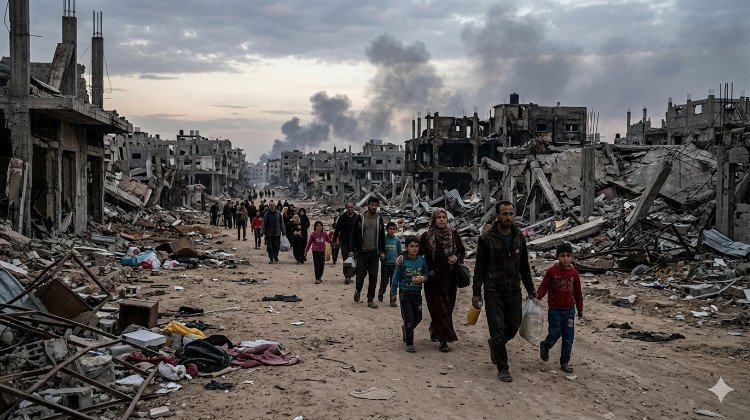
Despite being countless in number over the last few centuries, this Muslim population is defeated, humiliated, and insulted everywhere. One Muslim country after another is being destroyed, while the rest of the Muslim countries are just watching. It is as if they have nothing to do. Eighty million Muslims are living subhuman lives in refugee camps today. And our countries are not being run by the commands of Allah; the state system, economic system, judicial system—indeed, the entire system of life—is man-made, created by Western civilization, not created by Allah. Our constitution is not Al-Quran, it is a man-made constitution. Therefore, at a time when we are subjugated—that is, under man-made laws instead of Allah's laws—the time has come for us to rethink the Shariah validity of celebrating Eid from this perspective. Because the Messenger of Allah did not celebrate Eid before the establishment of a state system based on Tawheed.
Now let us see, what is the true significance of the Qurbani (sacrifice) of Eid-ul-Adha? Everyone will say that teaching the glory of sacrifice is the significance of Qurbani. But there is a huge question about how much of today's Qurbani is a sacrifice and how much is consumption. I see on social media that many, especially atheists, raise the question: where is the lesson of sacrifice in Qurbani? Here, it is only about consumption. They give only nominally to the people, and the rest they eat to their fill and store in the deep freezer. Some even mockingly say, apart from defecating after eating a bellyful of beef, we don't see any other sacrifice (tyag)! This question of theirs cannot be ignored. I am giving its answer.
Any deed depends on its intention (niyyah). If we sacrifice an animal for culinary indulgence, it cannot be called a sacrifice at all. But no matter how flawed our intentions are, someone is truly making a sacrifice. And that is the animal. It is sacrificing (giving up) its own life. So when we run the knife across its throat, we should remember that the animal also has a life and it too is the creation of Allah Almighty. Just as I have an attachment to life, so does it. When that animal sacrifices its life for us, we recite that verse of the Quran: "Qul inna salati wa nusuki wa mahyaya wa mamati lillahi rabbil alamin" (Meaning: Say, 'Indeed, my prayer, my rites of sacrifice, my living and my dying are for Allah, Lord of the worlds').
Domesticated animals are signs of Allah and creations devoted to serving humanity. There are many verses in the Holy Quran about domesticated animals, and even two Surahs are named after them—"Al-Baqarah" meaning the Cow, and "Al-An'am" meaning the Cattle/Livestock. Allah says, "And He created the cattle for you; you have in them warm clothing and (many) advantages, and of them do you eat." (Surah An-Nahl: 5). He further said, "And We have subdued them to them, so some of them they have for riding and some of them they eat." (Surah Ya-Sin: 72).
In this way, domestic animals serve human beings throughout their lives, because this is the purpose of their creation. On the day of Eid-ul-Adha, that animal sacrifices even its very life for humans. Thus it fulfills the highest right of its creation. Therefore, at the moment of slaughtering it and taking its life, we too must think about what the purpose of our creation is. How will our lives become meaningful? Just as Allah has created the sacrificial animal with a purpose, He has also created us for a great purpose: to fulfill the responsibility as His Khalifah or vicegerent on earth. Just as the animal fulfilled the purpose of its creation by giving up its life, similarly, if we too can dedicate our lives and wealth for the pleasure of Allah and for establishing peace in human society, only then will we be successful and achieve true success. This success is what is called Salvation in Christianity, Nirvana in Buddhism, and Moksha in Hinduism.
Sacrificing an animal is not obligatory for everyone; it depends on a person's capability and circumstances. But everyone has the capacity to dedicate their life and wealth in the path of Allah. There is no 'Nisab' or minimum financial threshold for this. Thus, sacrificing a cow is not Fard (obligatory), rather the Fard is to sacrifice oneself. And this is the true lesson of the Eid of Sacrifice.
True sacrifice is not complete until a person gives up their most beloved possessions. It is to explain this great truth that Allah established that incomparable ideal of sacrifice through Ibrahim (A.S.) and Ismail (A.S.), which has been teaching mankind the lesson of self-sacrifice for ages.
Eating the meat of the sacrifice has been made permissible for us, because the animal gave its life for this very purpose. But even after eating this meat, if I do not fulfill the main purpose of my life—that is, the responsibility of Allah's Khilafah (vicegerency)—then it will be extreme oppression and injustice; the question of true sacrifice or giving up does not even arise.
If I do not dedicate this life of mine in the path of Allah, then I am worse than that animal. This is why Allah has said: "Ula'ika kal-an'ami bal hum adall" meaning "They are like livestock; rather, they are more astray." (Surah Al-A'raf: 179). When a person takes the life of an animal but fails to fulfill his own responsibility, he becomes worse than that animal. Because there is no Rooh (spirit) of Allah within the animal, but there is within you and me. (Surah Al-Hijr: 29).
Therefore, the true meaning of the Qurbani of Eid-ul-Adha is not merely slaughtering an animal, but rather dedicating oneself to fulfilling the responsibility of Khilafah in the path of Allah is the real sacrifice.
Images Related to this Post








Leave a Comment