
The True Islamic Policy on Women
Category :
Islamic Thought & Analysis
-Rufaydah Panni
For several centuries, there has been a civilizational conflict between the East and the West. When the British established colonial rule, their European ideas, values, and lifestyle began to spread across India and other colonies through the education system and various institutions.
As part of this, Western perspectives on women also started influencing this region. The differences between Western views and Eastern traditions regarding women created a conflict. We have lived with this tension for centuries, yet it remains unresolved.
Western Proposals and Religious Leaders’ Response
During the tenure of the interim government, a reform commission on women’s policy was formed. It included academics, legal experts, women’s rights activists, NGO workers, and social workers. After extensive deliberation, they proposed a women’s policy that was rejected by religious leaders. Sensing their strong reaction, the government refrained from taking further steps.
The main reason for rejection was that the proposal reflected Western ideals. Some of its demands directly contradicted the fundamental teachings of Islam. For example, it proposed equal inheritance rights for sons and daughters.
However, according to divine law, a daughter receives half the share of a son. While this may appear unequal at first glance, a woman also receives financial support from her husband and shares in her children’s wealth, while her maintenance is the responsibility of her husband. On the other hand, a son bears financial responsibility for his parents, which a daughter does not. Thus, this system is presented as a balanced one.
The commission also proposed recognizing sex workers as laborers. However, prostitution is forbidden in Islam and other religions. Attempting to introduce such Western norms under the label of liberalism was seen as inappropriate. Therefore, it is essential to clearly understand Islam’s perspective on women’s policy.
Distortion by Clerical Systems vs. True Islamic Teachings
The problem is that people often cannot distinguish between true Islamic teachings and exaggerations by clerical systems. As a result, when Islam is discussed, examples like Afghanistan, Saudi Arabia, and Iran are often cited.
In 2022, 22-year-old Mahsa Amini died in the custody of morality police for allegedly improper hijab. During protests against this incident, over 500 people were killed in clashes with police. Yet, in Islam’s golden age, there was no such concept as “morality police.”
In 2025, after an earthquake in eastern Afghanistan, there were controversies over whether unrelated male rescuers could save trapped women. In Afghanistan, women are deprived of education, excluded from state leadership, and even barred from entering institutions meant for women’s affairs, which are run by men. Women must fully cover themselves and cannot travel without a male guardian.
Seeing such restrictions, many educated and aware individuals hesitate to accept Islam in state governance. In parliamentary elections, Islamic political parties fielded candidates in all seats but did not nominate a single woman, believing female leadership to be forbidden. They often cite a Quranic verse stating that men are protectors of women because they provide for them (Surah An-Nisa 4:34). However, this verse refers to family structure, not a blanket prohibition on women’s leadership in society or governance.
Women’s Participation and Empowerment in the Quran
To understand Islam’s stance, one must refer to the Quran and the life of the Prophet (peace be upon him). There is no verse in the Quran that explicitly prohibits women from leadership or participation in social and national life.
When the Quran addresses believers, it generally says “O believers,” which applies to both men and women. Core obligations—prayer, fasting, striving in the path of God, establishing justice, and truthfulness—apply equally to both genders. For example:
“O believers! Hold firmly to the rope of Allah all together and do not become divided” (Surah Al-Imran 3:103).
Another verse emphasizes collective responsibility:
“Believing men and believing women are allies of one another; they enjoin what is right and forbid what is wrong” (Surah At-Tawbah 9:71).
Thus, societal and state responsibilities are shared by both men and women.
Gender-Specific Guidelines
Where instructions are specific to a gender, the Quran addresses them directly. For example:
Women are instructed to guard their modesty (Surah An-Nur 24:31).
Men are similarly instructed (Surah An-Nur 24:30).
This shows that general commands apply to both genders, while specific ones are addressed individually.
Women’s Role in the Prophet’s Era
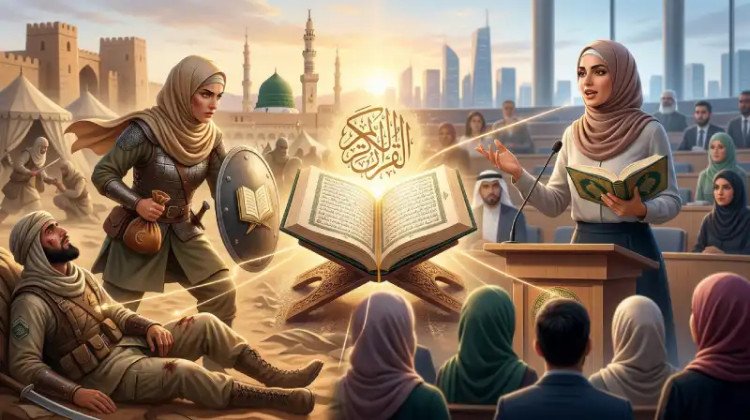
Islam does not forbid women from participating in social or national life. Historical practices under the Prophet (peace be upon him) demonstrate active female participation in all spheres—mosques, public gatherings, and even battlefields.
Women played crucial roles in wars by preparing food, treating the wounded, and sometimes even fighting. During the Battle of Uhud, the Prophet remarked that wherever he looked, he saw Umm Ammarah defending him.
Women regularly attended prayers, including Friday, Eid, and even night prayers. They also held leadership roles—for instance:
Shifa bint Abdullah supervised the market in Medina.
Samra bint Nuhayk oversaw the market in Mecca.
Rufaida Al-Aslamia led a medical unit treating wounded soldiers, training both men and women.
Despite this, modern education often highlights Florence Nightingale but overlooks figures like Rufaida. Prominent female companions such as Aisha and Umm Salama taught religious knowledge to large groups after the Prophet’s passing.
Women in Military Leadership
Even after the Prophet’s death, women continued to play active roles. During the Battle of Yarmouk under Caliph Umar, Khawla bint Al-Azwar served as a commander under Khalid ibn al-Walid and even rescued her captured brother from enemy forces.
The True Islamic Policy on Women
All of this demonstrates that Islam grants women the right to participate in social and national life and encourages their advancement. However, over time, distortions and excessive interpretations have confined women to domestic spaces.
Therefore, it is necessary to speak out against misinterpretations carried out in the name of Islam and to define women’s policy based on true Islamic teachings. Clerical dominance does not represent Islam. Rather, the divine framework of Islam provides women with dignity and the opportunity to stand confidently in every sphere of life.
Images Related to this Post
Tags:
Related Post





Search
Popular Post



Recent Post
Tags
Hezbut_Tawheed
Imam Hossain Mohammad Salim
Bangladesh Violence
Religious Extremism
Mob Attacks
Human Rights Violations
Minority Persecution
Rangpur Attacks
Jamaat-E-Islami
Hefazat-E-Islam
Tawheed
Muslim Ummah
Islamic Unity
Shirk
Kufr
Islamic Revival
Kalima-E-Tawheed
Obedience To Allah
Deen-Ul-Haq
Hizb-Ut-Tawheed
Ram Temple
Third Temple
Ayodhya
Jerusalem
Religious Politics
Babri Masjid
Al-Aqsa
Zionism
Hindutva
Netanyahu
Religious Hate
Muslim Unity
Noakhali Conference
Imam Salim
Islamic Movement
Shahidi Jame Mosque
Ht Members Conference
Bangladesh Religious Persecution
Islamic Reform Movement
Extremist Violence
Human Rights Bangladesh
Sonaimuri Noakhali Attack
Political Extremism Bangladesh
Faith-Based Violence
Eid Al‑Fitr
Zakat Al‑Fitr
Ramadan Charity
Islamic Social Justice
Community Harmony
Bangladesh Poverty
Islamic Economy
Sadaqah
Fitrana
Eid Unity
Arab History
Islamic Governance
Caliph Umar
Social Transformation
Women’s Rights In Islam
Justice In Islam
Political Systems
Islam Vs Democracy
Islam And Knowledge
Islamic System
Prophet Muhammad
Farewell Sermon
Hajj
Global Peace
Human Rights In Islam
Dhul-Hijjah
Arafat Sermon
Islam Vs Un Charter
Unemployment In Bangladesh
Education System Failure
Educated Unemployment
Jobless Graduates
British Education Legacy
Youth Crisis
Hezbut Tawheed Views
Bids Report
Ssc To Masters Job Race
Middle Class Dilemma
Kerani Mentality
Excessiveness In Religion
Religious Distortion
Overinterpretation Of Islam
Misguided Enthusiasm
Warnings Of The Prophet
True Islam
Spiritual Clarity
Abandoning The Mission
Chormonai Pir
Desherpotro
Islamic Reform
Persecution In Bangladesh
Religious Violence
Jamaat-E-Islami Attacks
Islamic Truth Movement
Women And Knowledge
Islamic Feminism
Gender Roles
Social Awareness
Muslim Women
Female Empowerment
Islamic History
Qur’anic Guidelines
Obeying Allah’s Commands
Islam And Suffering
Workers' Rights In Islam
Labor Justice
May Day Islam
Islamic Society Model
Chashirhat Development
Imam Hossain Mohammad Selim
Islamic Brotherhood
Fair Wages
Islamic Military Strategy
Tawheed-Based State
National Security
Qur’anic Warfare
Mujahideen
Peacekeeping
Modern Islamic Army
Military Training
Ummah Defense
Sharia Governance
Southasia
Extremism
Bangladesh
India
Pakistan
Myanmar
Jihad
Islamophobia
Radicalism
Resistance
Conflict
War
Terrorism
Proxywar
Bjp
Hasina
Ghazwa
Kashmir
Rohingya
Arsa
Militancy
Ideology
Unity
Awareness
Injustice
Arms
Geopolitics
Gaza
Hypocrisy
Taliban
Alqaeda
Afghanistan
Syria
Iraq
America
China
Russia
Media
Violence
Oppression
Nationalism
Muslim
Islam
Justice
Youth
Leadership
Sovereignty
Hezbuttawheed
Mosque
Governance
Society
Administration
Education
Military
Economy
Women
Culture
Law
Quran
Hadith
Prayer
Madinah
Baytalmal
Amir
Discipline
Khutba
Transparency
Spirituality
Training
Morality
Ummah
Prophet
Sharia
Community
Peace
Development
Security
National
Khutbah
Sabr
Zakat
Sufism
Equality
Mosquesystem
Participation
Aqiqah
Accountability
Tradition
Modernity
Ummati Muhammad
Unity In Islam
Sunnah
Islamic Teachings
Muslim World
Deen Of Islam
Security Crisis
National Unity
Political Unrest
Military Vulnerabilities
Strength
Solidarity
Disunity
Muslim Nations
Women's Rights
Rufaidah Panni
Eid Congregation
Islamic Women Empowerment
Social Justice
Equality In Islam
Momen
Kafir
Mushrik
Allah's Laws
Faith In Islam
Belief In Allah
True Believers
Kalimah
Shariah
Justice And Peace
Political Parties
Multiparty Democracy
Political Factionalism
Islamic Political System
Democracy Vs Islam
Secularism
Political Ideologies
Islamic Law
Political Vision
Governance Without Parties
Political Stability
Islamic State
Shura System
Islamic Perspective
Women’s Reform Commission
Family Law
Inheritance Law
Labor Recognition
Shariah Law
Gender Equality
Religious Opposition
Feminist Movement
Human Rights
Political Debat
Arab Society
Islamic Economic Justice
Military Transformation
Education In Islam
Judicial Independence
Accountability In Islam
Islam And Democracy
Societal Transformation
Governance Systems
Surah Yaseen
Islamic Guidance
Religious Work
Misguidance
Imam Role
Religious Commercialization
Truth And Falsehood
Religion And Society
Quranic Teachings
Ethical Leadership
Spiritual Struggle
Religious Scholars
Religious Corruption
Quranic Verses
Islamic Scholars
Prophet Muhammad (S.a.w)
Military Nation Of Islam
Sahabah
Lost Legacy
Ummah Of Muhammad
Jehad
Qetal
Islam And Violence
Islamic Leadership
State Vs Individual Struggle
Allah's Help
Islamic Reflection
Divine Support
Muslim World Crisis
Quran Teachings
Islamic Awakening
Qurbani
Bangladesh Politics
Eid Ul Adha
Islamic Sacrifice
Bangladesh Crisis
Global Conspiracy
Sacrifice
Labour Rights
Employment Crisis
Bangladesh Economy
Wage Gap
Inflation
Unemployment
Education Reform
Job Creation
Income Inequality
Post-Pandemic Economy
Eid-Ul-Azha 2025
Bangladesh Eid Congregation
Eid Prayer 2025
Women's Participation
Peace & Justice
Bangladesh Religious Events
Eid-Ul-Azha Message
Khilafah
Global Oppression
Islamic Festivals
Quranic Guidance
Spiritual Sacrifice
Ibrahim's Sacrifice
Eid Mubarak
Peace Through Tawheed
Women's Reform Debate
Bangladesh Women's Rights
Hezbut Tawheed Position
Islamic View On Women's Rights
Legal Reforms Bangladesh
Family Law Reform
Inheritance Rights
Sharia Law Bangladesh
Women's Equality
Western Influence
Religious Groups Debate
Gender Equality Islam
Islamic Social Solutions
Women's Dignity In Islam
Islamic Solutions
Beyond Politics
Labor Rights
Class Struggle
Economic Solutions
May Day Analysis
Economic Justice
Divine Accountability
Global Economic Crisis
Capitalism Vs Islam
Socialism Vs Islam
Savar Attack
Ishwardi Attack
Religious Fanaticism
Political Manipulation
Islamic Extremism
Government Response
Democratic Threats
Islamic Teachings Misuse
Radical Ideology
Communal Conflict
Radical Groups In Bangladesh
Terrorism In Bangladesh
Islamic Rights
Mosque Access
Eid Prayer
Muslim Women Empowerment
Prophet Muhammad Teachings
Women In Mosques
Women Rights In Islam
Gender Equality In Islam
Masjid An-Nabawi
Women's Role In Islam
Misconceptions About Women
Women Participation In Mosque
Eid Khutbah 2025
Islamic Sermon
Hossain Mohammad Selim
Bangladesh Eid
Qurbani Meaning
Women In Islam
Rufaydah Panni
Islamic Congregation
Female Participation In Eid
Chashirhat Eid
Palestine Solidarity
Eid Prayer Bangladesh
Women In Eid
Kushtia Rally
Gaza Crisis
Muslim Persecution
Bangladesh News
Peace Movement
Humanity
Divine Law
Social Reform
Religious Harmony
Truth
Call To Action
Palestine
Dajjal
Islamic Struggle
Mohammad Bayazid Khan Panni
Genocide
Oic
Protest
National Press Club
Rangpur Attack
Religious Reform
Karwan Bazar Protest
Terrorist Attack
Law And Order Failure
Emamht
Ht_In_Brief
Pabnaattack
Justiceforvictims
Humanchain
Politicalviolence
Legalreform
Endimpunity
Bangladeshjustice
Hezbuttawheedleaders
Demandjustice
Pabnapressconference
Policeinaction
Proposedgovernancesystem
Islamicstatesystem
Allahslaw
Economicreform
Educationreform
Capitalismcritique
Dhakaevent
Purposeofcreation
Humancreation
Khalifah
Allahsplan
Divineguidance
Adamsstory
Islamicteachings
Peaceandjustice
Sovereigntyofallah
Lailahaillallah
Islamiccreed
Aqidah
Islamicfaith
Iman
Deen
Peaceinislam
Purposeofislam
Beliefsystem
Faithandworship
Why
Escalate
Mohammad Bayazeed Khan Panni
Hossain Mohammad Salim
Religious
Extremist
Interfaith
Situation
Ultimatum
Threats
Extremist Attack
Attack
Movement
Barakat Hossain Osama
United Kingdom
Conservative Party
Donald Trump
Secular Leadership
Fanatical Populace
Fanatical
Populace
Religion
Extensive Damage
Catastrophic Flooding
High School
Urgent Help Needed
Devastated
Allah
Modus Operandi
Messenger
Believer
Messenger Of Allah
People
Human
Jame Mosque
A Cornerstone
Cornerstone
A Just Society
The Establishment
Establishment
History
Messenger Muhammad
Simple And Straightforward
Who Made
The Simple
Complex
Way Of Life
Jannah
Way To Jannah
Civilization
Religious Figures
Survive
Politics
Worship
Establish
Goals And Objectives
System Of Life
Money
Tolerance
Madness
Mo'men
Today’s
Educated
Needs
Corruption
British
Government
Democracy
Communism
Socialism
Political
Secular Education
Responsible
The Reign
Hindu
Terrifying
Slavery
Jewish Conspiracy
The Protocols Of The Elders Of Zion
Politician
Give And Take
Education System
European
Population
Mentality
Slave
Preface
Children
The Quran
The Miracle
Creator
The Creator
Creation Of Man
The Creation Of Man
Premise
First Words
Aqida
The Programme
The Messenger
Mankind
Actual
Concept Of Islam
Crossroads
Mojeza
The Call
Panni
The Author
Qur'an
Process
The Process
A Person
Tabook
The Special Three
Special
The Tabook
The Ahzab
Ahzab
Khandak
The Uhud
Uhud
The Badr
Badr
Ebadat
Ma'bud
Vicegerent
Worshipper
Aqaed
The Reasons
Reasons
Reason
Adam
Eblis
Khalifa
Angels
Adam And Eve
Adam And Hawa
Leave a Comment