
The Sorrowful History of Palestine
Category :
Islamic Thought & Analysis
Obaidul Haque Badal:
Since 2023, nearly 100,000 people have been killed in Gaza, the majority of whom are children and women. Over 150,000 Palestinians have been injured. Almost everyone in Gaza is now displaced. With a severe crisis of food, water, and medicine, Gaza is now a city of death. Displaced people are being shot and killed while standing in food lines; such precedents have called the civilization of the 21st century into question. Palestine is not just the name of a territory; it is a heartbreaking history, a long, continuous reflection of struggle and resistance. From ancient times to the modern era, it is one of the most discussed, controversial, and bloody regions in the world. The history of Palestine is a fundamental chapter not only for the Muslim world but for human civilization as well.
Ancient Palestine and the Roman Era
In 70 AD, the Roman Empire destroyed the city of Jerusalem and the Second Temple of the Jews. During this time, many Jews were killed and expelled. In 135 AD, after suppressing the "Bar Kokhba revolt," the Romans completely uprooted the Jews from Jerusalem and forced them to scatter to various parts of the world. In history, this is known as the "Jewish Dispersion." Since then, Jews scattered and settled in different places across the world, including Europe.
After that, the Palestine region remained under Roman rule. Later, it changed hands between the Byzantine and Persian empires. But when Islam emerged in the 7th century, under the leadership of Caliph Umar (R.A.), the Muslim forces conquered Palestine from the Roman Christians, who were the superpower of that time. Under Muslim rule, Jerusalem turned into a city of peace. Subsequently, alongside the local Christians, some Jews also came and lived safely.
Meanwhile, for centuries, Jews scattered in various parts of the world, including Europe, faced genocide. The inherent flaws of the Jews bred hatred towards them among people, and everyone considered killing them to be justified. Wherever they took shelter in the world, they were beaten. The Christians of Russia and Europe would collectively attack and indiscriminately massacre them. For centuries, such attacks on the Jews happened so many times that this type of attack got a distinct name. A new word was coined: 'Pogrom'. The word 'pogrom' was used to denote a collective attack aimed at exterminating a specific race.
Lastly, during the Second World War, Adolf Hitler's Nazi forces and their allies killed about six million Jews. This genocide is known in history as the 'Holocaust'. History says that Jews were actually safe and secure under the protection of Muslims.
Salahuddin and the Crusades
In the 11th century, Christian Crusaders captured Jerusalem and carried out widespread massacres and looting against Muslims. In 1187, Muslim military commander Salahuddin Ayyubi recaptured Jerusalem. Instead of seeking revenge, the Muslims showed generosity towards the Christians and maintained peace, which is regarded in history as a rare example of humanity.
Ottoman Rule and Colonial Aggression
In the 16th century, Palestine came under the Ottoman Empire and remained under Muslim rule until 1917. However, after the fall of the Ottomans during the First World War, the British took over the entire Arab region through colonial agreements. Palestine also fell under British control.
The Arrival of Jewish Refugees and the Beginning of the Conspiracy
In the 1930s, the British gave shelter in the 'Kibbutzim' of Palestine to Jews who were victims of persecution in various European countries. Taking refuge as refugees, they slowly and tactfully built some residential areas there with the help of the British. Then, after the Second World War of 1939-45, the West looked for a "permanent homeland" for the Jews. Although the vast barren lands of Australia lay vacant, they conspiratorially targeted a weakly-armed Palestine. After 1945, about 5.7 million Jews were relocated from Europe and rehabilitated in Palestine. Although the Palestinians protested this, it failed due to the military and political support of the British and the West. Jewish settlements were built by occupying the lands of the Palestinians. From this time, anger, protests, and conflicts began among the Arabs.
1947: UN Partition Plan
In 1947, the United Nations proposed dividing Palestine into two parts: one a Jewish state (Israel) and the other an Arab state (Palestine). The Palestinians and Arab countries protested against it. But with Western support, the Jews declared a state named 'Israel' in 1948. As a result, the first Arab-Israeli war started. In this war, Israel expelled about 800,000 Palestinians from their homeland, which is called the 'Nakba' (Catastrophe). Thousands of villages and towns were destroyed, and Palestinians started living in refugee camps. The occupying Jews settled permanently, while the locals had to leave their country for refugee camps.
1967: The Six-Day War and the Occupation of Jerusalem
In 1967, a six-day war took place between Israel and Egypt, Jordan, and Syria. With the power of the West, Israel occupied Jordan's West Bank, Egypt's Gaza and Sinai Peninsula, and Syria's Golan Heights in this war. The entirety of Jerusalem also came under Israeli control. Oppression and persecution against Palestinians increased. Meanwhile, the West continued to directly and indirectly support all the crimes of Israel, and even provided all kinds of assistance.
1973: The 'Yom Kippur War'
In the 1973 Arab-Israeli war, known as the 'Yom Kippur War', Egypt and Syria jointly launched a campaign against Israel. Despite initial success, Israel ultimately reversed the situation with a counterattack aided by the West. However, the fate of the Palestinians did not change.
Palestinian Resistance and Hamas
Under the leadership of Yasser Arafat, the founder of the Palestine Liberation Organization (PLO), the Palestinian struggle for independence continued for many years. In 1987, the Palestinians started the 'Intifada' (uprising). Mass protests against Israel spread across Gaza and the West Bank. Subsequently, through the Oslo Accords of 1993, led by Yasser Arafat, self-rule under the Palestinian Authority was established in the West Bank and Gaza Strip. But the agreement contained no mention or even a hint of an independent state.
At this time, aiming to achieve the independence of Palestine, an organization named 'Hamas' emerged under the leadership of Abu Yasin. They started a war of independence against occupying Israel. Elections were held democratically in the two geographically separated parts of Israel, the West Bank and the Gaza Strip (the distance between which is 75 km). PLO's Mahmoud Abbas won in the West Bank, and Hamas's Abu Yasin won in Gaza. The authority of the two leaders was established in the two territories. While the West Bank accepted Israeli authority, Hamas in Gaza continued the struggle for independence. The West consistently ran propaganda calling this pro-independence organization a terrorist group.
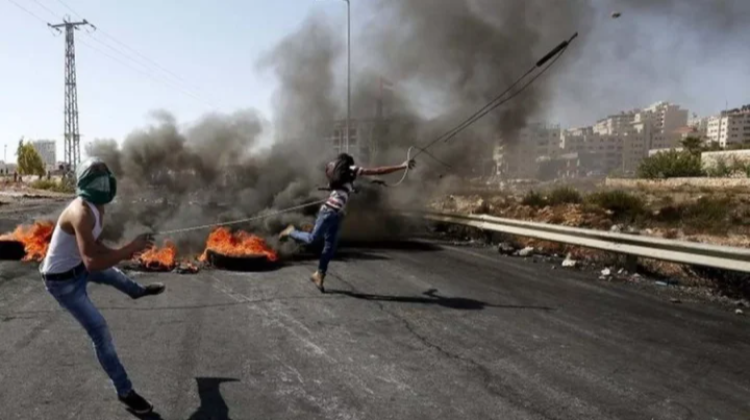
In 2014, tensions reached their peak following an attack by Israeli soldiers on Muslims praying in the Al-Aqsa Mosque. The sight of a female soldier kicking and insulting worshippers, including children, sparked global outrage. At this time, Hamas launched rocket attacks against Israel. Meanwhile, Israel launched severe airstrikes on Gaza. Thousands of people were killed, mostly women and children.
2023-24: Another Name for Genocide is 'Gaza'
When Hamas launched its largest attack on Israel in October 2023, Israel also launched a brutal military operation in Gaza. A genocide against the Palestinians began with the direct support of the United States. Ignoring the calls of the United Nations and the international community, they violated all rules of war and carried out indiscriminate massacres; schools, hospitals, relief convoys, and refugee camps were not spared from bombings.
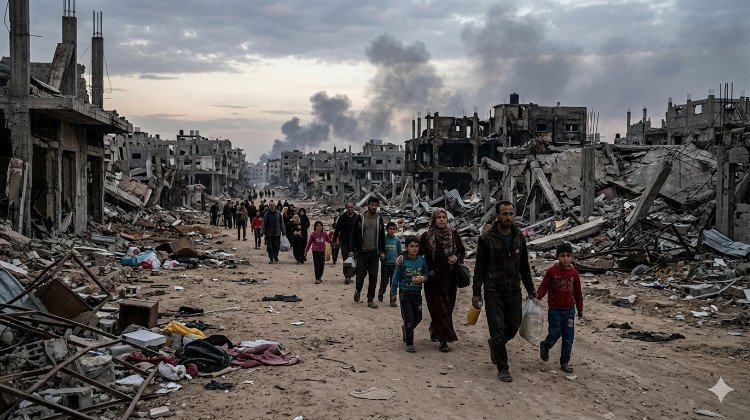
Since 2023, nearly 100,000 people have been killed in Gaza, the majority of whom are children and women. Over 150,000 Palestinians have been injured. Almost everyone in Gaza is now displaced. With a severe crisis of food, water, and medicine, Gaza is now a city of death. Displaced people are being shot and killed while standing in food lines; such precedents have called the civilization of the 21st century into question. The history of Palestine is not merely a Jewish-Arab conflict; it is the cruel reality of global politics, where a nation has been evicted from its motherland to build a state of injustice using the power of weapons and money.
When the Western world speaks of human rights, their morality is stained with the blood of Palestinians. The whole world has witnessed the merciless scenes of the slaughter of thousands of women, children, and unarmed people in Gaza by Israel's barbaric attacks. This genocide was carried out with the open support and military backing of the United States. But the most painful thing is the indifference of the Muslim world. Even though the hearts of Muslims around the world are shattered, Muslim countries—let alone mounting any effective protest—have merely confined themselves to issuing statements and offering prayers, while blaming one another.
Yet Islam has taught us, "A Muslim is the brother of another Muslim." If one brother is attacked, the other brother will stand by his side—this is the demand of faith. For this reason, the Holy Prophet (PBUH) compared the mutual condition of the believers to a single body, saying: 'The parable of the believers in their mutual love, mercy, and sympathy is that of a human body. When one of its limbs is afflicted, the entire body responds with sleeplessness and fever.' - Muslim, Hadith: 6480.
The Ummah that the Prophet (PBUH) built as "one body, one soul" is today torn apart by factionalism, division, and various sects in the name of Mazhabs. No one stands by anyone's side; instead, they often join hands with the enemy and stand against their own brothers. Is this the identity of the Ummah that claims to be the 'Ummah of Muhammad'? Allah has said, "And hold firmly to the rope of Allah all together and do not become divided." - Surah Ali 'Imran: 103.
But in reality, we are walking completely opposite to this command of His. Today, this ongoing oppression, occupation, and genocide against the Muslim nation is the consequence of our disunity, forgetting our self-identity, and deviating from the Deen of Allah. Gaza is not just a territory; it is the testing ground for Muslim brotherhood. The Muslim world has failed that test.
Images Related to this Post










Leave a Comment