
Trade Agreement with the United States: Gains and Losses for Bangladesh
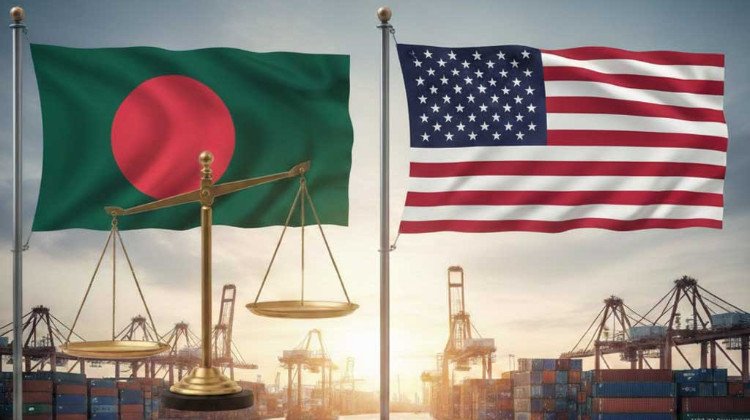
Bangladesh currently stands at a difficult geopolitical and economic crossroads. On one hand, there is intense scrutiny of the new trade agreement signed with the United States after nine months of negotiations. On the other hand, under pressure from the global energy crisis, Dhaka is knocking on Washington’s door to import oil from Russia. At this critical juncture in 2026, a major question looms: is this agreement a blessing for Bangladesh’s economy, or a strategic compromise of sovereignty?
At the beginning of 2025, Donald Trump returned to power for a second term, creating turbulence in the global economy. As part of his “America First” policy, Bangladesh’s ready-made garments faced a threat of a 35% retaliatory tariff. In the final phase of the interim government, on February 9, 2026, the “Agreement on Reciprocal Trade” (ART) was signed. Under this deal, tariffs on Bangladesh were reduced slightly—from 20% to 19%. Along with this 1% reduction, garments made using U.S. cotton and synthetic fibers were promised zero-tariff access.
At first glance, a 1% tariff reduction and duty-free access for certain garments may seem like a success. However, a deeper look into the 32-page agreement reveals a different picture. Experts are calling it a “one-sided” deal. In exchange for these limited benefits, Bangladesh has committed to purchasing $15 billion worth of LNG over the next 15 years from the U.S., at least 14 Boeing aircraft from Boeing, and agricultural products worth approximately $3.5 billion annually. This raises a critical question: why make such large commitments without fully considering national capacity?
Clause 4.3 of the agreement is particularly concerning. It states that if Bangladesh enters into major economic or free trade agreements with “non-market” countries like China or Russia, the United States reserves the right to terminate the bilateral agreement. This significantly restricts Bangladesh’s policy independence. Additionally, provisions in digital trade—such as reduced control over data and the requirement to use U.S.-based logistics platforms—could pose serious cybersecurity risks.
For the garment sector, the biggest incentive was duty-free access if U.S. cotton is used. However, Bangladesh’s spinning mills typically import cheaper cotton from India, Brazil, or Africa. U.S. cotton is more expensive and involves longer shipping times. If manufacturers switch to costlier cotton just to save 19% tariffs, production costs will rise, making Bangladeshi garments less competitive globally. Buyers may shift to cheaper alternatives, raising concerns that this “benefit” could ultimately backfire.
Amid this trade controversy, another major challenge has emerged: skyrocketing energy prices. Due to ongoing tensions between Iran and Israel, global supply chains are under strain. In this situation, affordable Russian oil has become crucial for Bangladesh’s economic stability. However, due to U.S. sanctions on Russia, direct imports are not possible.
In this context, Finance Minister Amir Khasru Mahmud Chowdhury has formally requested a waiver from the U.S. ambassador to allow the import of Russian oil. The argument presented is simple: if India can import Russian oil, why not a developing country like Bangladesh?
Without U.S. approval, any transaction with Russia risks triggering “secondary sanctions.” This could isolate Bangladesh’s major banks from the global financial system. Moreover, Western insurance companies are unwilling to cover Russian oil shipments. For these reasons, the government has chosen negotiation with Washington rather than taking immediate unilateral action. As a result, Bangladesh’s ability to import Russian oil now depends largely on U.S. approval.
The agreement has also sparked intense debate within Bangladesh’s political and civil society. Various groups, including the Communist Party, have labeled it a threat to sovereignty and demanded its cancellation. The current Commerce Minister Khandaker Abdul Muqtadir has acknowledged that certain clauses may need review. Business leaders warn that domestic industries—such as pharmaceuticals and ceramics—could face increased competition, as U.S. products may enter the Bangladeshi market with reduced or zero tariffs.
Bangladesh now faces a dual challenge. On one side, it must review the “unequal” trade agreement to protect domestic industries and revenue. On the other, it must secure U.S. approval to manage its energy crisis through Russian oil imports. Without a firm diplomatic stance like India’s, Bangladesh risks falling behind in this geopolitical landscape.
The trade agreement with the United States could have been an opportunity if it were based on equality. However, in its current form, the list of sacrifices appears longer than the gains. Is it truly justified to compromise policy independence and commit vast foreign currency reserves for a mere 1% tariff reduction?
Similarly, relying on U.S. approval to import Russian oil highlights the fragility of Bangladesh’s energy security. The time has come to strengthen domestic capacity and diversify markets. Only through a balanced foreign policy and strong diplomatic negotiations can Bangladesh navigate this crisis. Otherwise, the growing risk of losing control while keeping the door open to external influence may pose serious long-term threats to the nation’s economy.
Images Related to this Post










Leave a Comment