
Women’s Rights in True Islam
-Rufaydah Panni
For the past several centuries, there has been a civilizational conflict between the East and the West. When the British established colonial rule, their European ideas, values, and ways of life began to spread through the education system and various other means across the Indian subcontinent and other colonies. As part of this, Western perspectives on women also started influencing this region. The differences between Western views and Eastern policies and reforms regarding women led to conflict. We have spent centuries dealing with this conflict, yet no resolution has been reached.
Western Proposals and Religious Leaders’ Reactions
During the tenure of a previous interim government, a reform commission on women's policy was formed. This commission included academics, legal experts, women's rights activists, NGO workers, and social workers. After extensive study, they proposed a women's policy which was rejected by religious leaders. Sensing their strong reaction, the government did not proceed further on the matter.
The main reason for the rejection was that the proposal reflected Western women's policy. Some of its demands were in direct conflict with the fundamental teachings of religion. For example, it proposed that sons and daughters should receive equal inheritance from their father. However, according to divine law, a daughter receives half the share of a son. At first glance, this may seem unequal, but a woman also receives wealth from her husband and son, while her maintenance is the responsibility of her husband. On the other hand, a son bears the responsibility of supporting his parents, which a daughter does not. Thus, this system maintains balance.
The commission also proposed that sex workers be recognized as laborers. However, prostitution is prohibited in Islam as well as in all religions. This was seen as an attempt to introduce Western immoral culture into our society under the guise of liberalism. Therefore, it is essential to clearly understand Islam’s perspective on women.
Distorted Clericalism vs. True Islamic Teachings
The problem is that we often fail to distinguish between true Islamic teachings and the excesses of clericalism. As a result, when Islam is discussed, examples such as Afghanistan, Saudi Arabia, and Iran are brought forward. In 2022, a 22-year-old woman named Mahsa Amini died in custody of morality police over allegations of improper hijab. During protests against this incident, over 500 people were killed by police gunfire.
However, during Islam’s golden age, there was no such concept as morality police. Similarly, in 2025, after an earthquake in eastern Afghanistan, confusion arose over whether unrelated male rescuers could save women trapped under debris. Women in Afghanistan are deprived of education, excluded from state responsibilities, and even barred from entering ministries designated for women. They must be fully covered outside and accompanied by a male guardian.
Seeing such restrictions, many educated people do not want Islam in public life. In a recent parliamentary election, Islamic parties nominated candidates in all constituencies but did not nominate a single woman. They even nominated non-Muslims but not women, believing female leadership is forbidden. They justify this using a Qur’anic verse stating that men are guardians over women because they provide for them (Surah An-Nisa 4:34). However, this verse relates to family structure, not a blanket ban on women’s leadership in society.
Women’s Participation and Empowerment in the Qur’an
To understand Islam’s perspective, we must refer to the Qur’an and the life of the Prophet. Nowhere does the Qur’an prohibit female leadership or participation in social and national affairs. When addressing believers, the Qur’an generally says “O believers,” which applies to both men and women.
Core responsibilities such as prayer, fasting, striving in the path of God, establishing justice, righteousness, and truthfulness apply equally to both genders. For example, the Qur’an states:
“O believers! Hold firmly to the rope of Allah all together and do not become divided” (Surah Al-Imran 3:103).
Another verse explicitly states:
“Believing men and believing women are allies of one another; they enjoin what is right and forbid what is wrong” (Surah At-Tawbah 9:71).
Thus, societal responsibilities are not limited to one gender but shared by both.
Gender-Specific Instructions
Where specific instructions apply to women, they are addressed directly:
“Tell the believing women to lower their gaze and guard their modesty” (Surah An-Nur 24:31).
Similarly, men are addressed separately:
“Tell the believing men to lower their gaze and guard their modesty” (Surah An-Nur 24:30).
This shows that general commands apply to both, while specific ones are clearly distinguished.
Women’s Participation in Early Islam
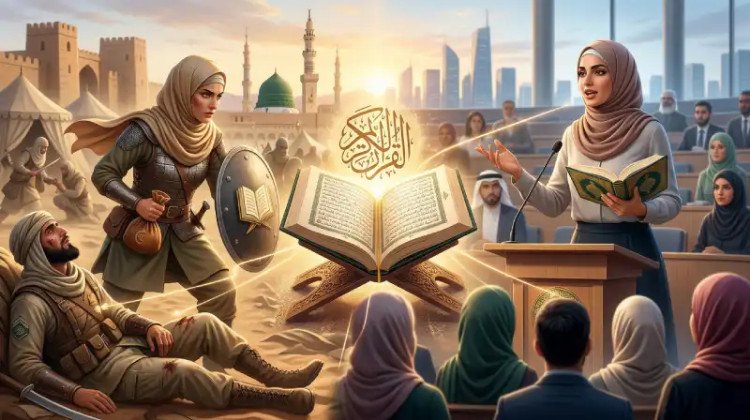
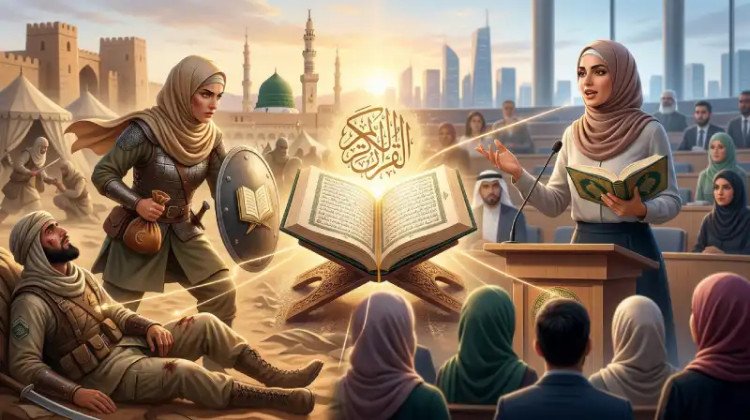
The idea that Islam prohibits women from participating in public life is incorrect. Many modern restrictions come from later interpretations rather than the Qur’an or the Prophet’s example. During the Prophet’s time, women actively participated in all areas of life—mosques, gatherings, and even battlefields.
Women played key roles in supplying provisions during war, preparing food, treating the wounded, and sometimes even fighting. In the Battle of Uhud, the bravery of Umm Ammara was so remarkable that the Prophet said he saw her fighting on all sides.
Women attended daily prayers, Friday prayers, Eid prayers, and even night prayers in mosques. They also held leadership roles—such as market supervisors in Madinah and Makkah. Rufaida al-Aslamia led a field hospital, where both men and women trained under her. While Florence Nightingale is widely known, her name is often overlooked.
Aisha and Umm Salama also taught religious knowledge to large groups after the Prophet’s passing.
Women’s Leadership in Battle
Some argue these examples occurred before the revelation of verses on modesty, but this is incorrect. Women continued to play active roles even after. During the Battle of Yarmouk, Khawla bint al-Azwar commanded a unit under Khalid ibn al-Walid. She even rescued her brother from enemy captivity by breaking through enemy lines.
The True Islamic Policy on Women
Thus, it is clear that Islam grants women the right to participate in social and national affairs and encourages their progress. However, due to later distortions, excessive restrictions have confined women to their homes in the name of modesty.
We must speak out against these misconceptions and determine women’s roles based on true Islamic teachings. It is important to remember that clericalism is not Islam. Only the divine guidance provided by Allah ensures dignity and empowerment for women in all aspects of life.
Images Related to this Post






Leave a Comment